Showing posts with label Bernie Sanders. Show all posts

Thursday, December 15, 2016

Democrats don't get it

This post is going to piss off a lot (all?) of my Democrat friends. So be it. But we Democrats need to do a reality check.

Item #1: The electors are not going to not elect Donald Trump. It doesn't matter if that petition got 10 million signatures. Save your op-eds, your pleas, and your sanity. It ain't going to happen. Thirty-seven Republican electors are not going to not elect Trump.

Sure, maybe a couple of them will vote for someone else, another Republican. But as has been proven again and again -- and again -- Republicans always fall in line. And the Republican electors will cast their votes for Trump. And on the slim chance that 37 of them decide to do otherwise, the decision will get thrown to Congress. And guess what? They're not going to make Hillary Clinton -- or Bernie Sanders -- the next President of the United States. But if it makes you feel a wee bit better to sign some petition begging a bunch of Republicans to not vote for the Republican candidate, go ahead.

Item #2: Republicans will fall in line and confirm all of Trump's cabinet -- and Supreme Court -- appointments (or almost all of them). Forget the kvetching and big talk from Marco Rubio and Lindsey Graham et al. It's all just bluster. When it comes down to a vote, the Republicans will all fall in line and confirm Trump's cabinet and Supreme Court appointments, no matter how awful they are. Sure, one or two Congressfolk may dissent, but more for show, knowing someone else will cancel out their nay.

Item #3: Democrats in Congress will roll over, or compromise, like they always do. Just the other week there was big talk that the Democrats would let the Republicans flounder after repealing or gutting Obamacare -- that is, they wouldn't sign on to any legislation that offered less than what the Affordable Care Act offered. Yet now -- no surprise -- I am reading and hearing that (some? most?) Democrats will "work with" their Republican brethren, so that only, say, 19.95 million people lose their health insurance, or have to pay a fortune for insurance, instead of 20 million.

Look, I get it. A lot of these Democrats are up for reelection in 2018 and they feel that something is better than nothing. But if Democrats want to take back the Senate and House, they need to stiffen their spines and stand tall, instead of bending over and letting the Republicans give it to them.

Item #4: Bernie Sanders is not going to save us. I grant you that if the contest had been between Bernie Sanders and Donald Trump, we may very well have been talking about President-elect Bernie Sanders right now. But Hillary Clinton was who Democrats voted for, despite all of the negative press about Hillary, by MILLIONS of votes. And I very much doubt Putin and the Russians had anything to do with that outcome.

Also, it is important to note that while a President Sanders would be much more palatable, at least to a large portion of the population, than President Trump, he wouldn't have gotten anything done. And all of his big campaign promises -- making college free, medicare for all, a $15 minimum wage, reforming Wall Street -- which sound great, but would require raising taxes and/or increasing the debt, substantially, would never be approved/get passed by Congress.

You think Congress was obstructionist under President Barack Obama, who looks practically Conservative compared to Bernie? You can bet your bippy Republicans would do their level best to make sure a President Sanders got nothing done -- or worse, would still pass all sorts of harmful legislation or repeal legislation and executive orders passed under Obama, because they probably have the votes to do so.

Item #5: Wishing won't make it so, and ignoring reality, or the news, won't make Trump go away. So where do Democrats go from here? We fight to take back the Senate and House, by supporting and campaigning for Democratic candidates. And we tell representatives in the House and in the Senate not to roll over, by writing and calling them. And we, or our elected officials, file lawsuits against Donald Trump, as these attorneys general plan or may do.

Wednesday, May 18, 2016

2016 Democratic Primary Race Vote Update (No throwing chairs!)

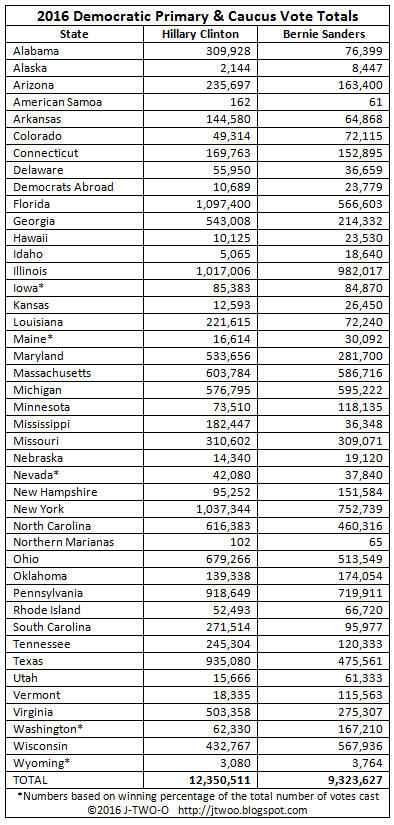
So when this blog last printed the vote totals for Bernie Sanders and Hillary Clinton, back on April 27th, Hillary was leading Bernie by just over 3 million votes. So where do the Democratic candidates for President now stand?

Here is my updated table showing 2016 Democratic Primary & Caucus Vote Totals:

[Click on the image to enlarge it.]


As of this writing (with 96% of the votes reported for Oregon, which was the latest total as of this writing), Hillary Clinton is still leading Bernie Sanders -- by 2,890,670 votes.

Put in delegate terms, Clinton leads Sanders by 274 pledged delegates (which does not include super delegates), with Clinton having 1,768 pledged delegates and Sanders amassing 1,494 pledged delegates.

A few interesting facts about the recent Democratic contests:

* Hillary "crushed" Bernie in Guam, winning 59.5% of the vote to Bernie's 40.5%. Which just goes to show you how you need to read beyond the headlines. While it is true that Hillary, percentage-wise, "crushed" Bernie, in terms of actual votes, it wasn't a big deal -- 777 (Clinton) to 528 (Sanders).

* Clinton and Sanders were each awarded 27 delegates in Kentucky, even though, technically, Hillary "won." That's because the Democrats use the proportional method (which is not to be confused with the rhythm method, though can be just as or more confusing) of awarding delegates to candidates.

* States with large white populations (especially white, male, working class and/or young, white, male populations) and low black and Hispanic populations tend to vote Sanders whereas states that "look like the Democratic party" (i.e., are more diverse) tend to vote Clinton, which would seem to predict wins for Clinton in California and New Jersey (two delegate-rich states) and possibly New Mexico.

NEXT UP, contest-wise: The U.S. Virgin Islands on 6/4; Puerto Rico on 6/5; California, New Jersey, Montana, New Mexico, North Dakota, and South Dakota on 6/7; and Washington, D.C., on 6/14. So expect my next update on 6/8.

Wednesday, April 27, 2016

Hillary and Bernie Election 2016: The voters have spoken (again)

Before Super Tuesday IV, or the Acela Primary (as some pundits had been calling it), Hillary Clinton had been leading Bernie Sanders by over 2.5 million votes. Yesterday, Clinton increased her lead to just over 3 million votes, as you can see from my updated 2016 Democratic Primary & Caucus Vote Totals table below. (Click on the image to enlarge it.)


Of note, Clinton beat Sanders nearly 2 to 1 -- 533,656 vs. 281,700 votes -- in Maryland and by nearly 200,000 votes in Pennsylvania (918,649 vs. 719,911 votes), which was and is considered a must-win state in both the primaries and in the general election.

Connecticut was a bit of a nail biter, with Clinton ultimately beating Sanders by about 17,000 votes (169,763 vs. 152,895 votes). However, Sanders beat Clinton in Rhode Island, by a margin of 14,000, which was less than the margin of the Clinton wins, including Connecticut and Delaware, where she beat Sanders by over 19,000 votes.

Of course, as we all (or most -- or some -- of us) know, it's not ultimately votes that get you to the party convention and win you the nomination but delegates. Though in most states it's votes that get you delegates. And as of 7:30 this morning, Hillary Clinton had 1,640 pledge delegates to Bernie Sanders 1,331 pledged delegates*. Add in super delegates (who, btw, have never decided or compromised an election, voting with the majority of voters) and Hillary's total rises to 2,159 delegates and Bernie's to 1,370 -- with the magic number to win the Democratic nomination being 2,383.

Unless you believe in Bernie Math (see below) and unicorns, it seems pretty clear at this point that Hillary Clinton will be the Democratic nominee for President of the United States in 2016.

To be continued...?


*Depending on which news organization's number you use.

Wednesday, April 20, 2016

Hillary, Bernie + How New York Voted: Election 2016 Democratic Vote Update

So which Democratic candidate did New Yorkers vote for in the 2016 presidential primary? Was it Bernie, the Bro from Brooklyn, who left the City in 1960 to attend the University of Chicago, settled in Vermont in 1968, and went on to serve in the House of Representatives and the Senate representing Vermont (as an Independent, not a Democrat)?

Or was it the carpetbagger, Hillary, who grew up in Illinois, attended Wellesley in the 1960s, and then lived most of the 1970s and 1980s in Arkansas before moving to D.C. in 1993 and to Chappaqua, New York, in 1999 -- going on to represent her adopted state of New York as Senator in the 2000s (and serving as Secretary of State from 2009 to 2013)?

Even if you are not a news junkie (as I am), you probably already know that Hillary Clinton won the New York primary election -- and by a significant amount. What is a "significant" amount, you ask? With 98 percent of precincts having reported, Clinton had 1,037,344 votes while Bernie Sanders had 752,739. So Clinton beat Sanders by more than 250,000 votes -- or, put another way, by 16 percent.

Bernie Sanders had a strong showing in upstate New York, especially in rural areas touching or close to his home state of Vermont. (For those of you geographically challenged, Vermont is right next to the Northeast corner of New York State.) However, Hillary Clinton dominated the New York City metro area, i.e., New York City, Long Island, and Westchester -- and won in Buffalo, Rochester, and Syracuse, too.

So where do the candidates now stand, in terms of total number of votes (as opposed to delegates)? Here's my latest table, which now includes Wyoming, where approximately 7,000 Democrats caucused earlier this month, and New York, a closed primary state, where nearly 1.8 million Democrats voted.

[Click on the table to enlarge it.]


So, as of today, Wednesday, April 20, more than 10.6 million people have voted for Hillary Clinton and more than 8 million have voted for Bernie Sanders. And Hillary leads Bernie by close to 2.6 million votes.

However, as most people know, it's not total votes that count or win elections, it's delegates. And Clinton currently has 1,446 pledged delegates (based on contests she has won), whereas Sanders has 1,200 pledged delegates (based on contests he has won). And when it comes to super, or unpledged, delegates, Clinton has 502 versus Sanders's 38. The magic number to win the Democratic nomination: 2,383.

While it is not impossible for Bernie Sanders to win the Democratic nomination for president, it's not going to be easy. And before any of you start squawking about the nominating process, I KNOW. It seems totally unfair, especially to Bernie supporters. But it is what it is -- and the system was set up long before Hillary ever ran for President. And even if you hate the delegate system, Clinton is still leading Sanders by nearly 2.6 million votes.

Wednesday, April 6, 2016

Hillary, Bernie & Wisconsin: Vote update

So, as I wrote on Monday, I've been following the primary (and caucus) process, and I was curious to know how many votes -- not delegates -- Bernie Sanders and Hillary Clinton had actually accrued. So I went online and looked up the official vote totals for each state.

However, I didn't initially realize that the totals for many caucus states, such as Iowa and Maine, were not actual votes but state delegates awarded (until a friend pointed out that 171,109 people voted in the Iowa Democratic caucuses). So, I went back and searched the Internet to find the total number of votes cast in each caucus state and, if I could not find a vote total for each candidate, divvied up the votes according to the percentage each candidate had won. Then I added up the votes, state by state -- and discovered that Hillary Clinton had garnered over 2.4 million more votes than Bernie Sanders -- and blogged (and tweeted) about it.

Then the spouse said to me, "You should make a table!" So I made a table, listing the number of votes cast for Hillary Clinton and the number of votes cast for Bernie Sanders in each state. And I just updated it to include the results from Wisconsin, which is an open primary state, meaning anyone can vote for anyone -- so perhaps not an accurate barometer of how people would vote in the general election (as there was a lot of chatter about Democrats voting for Cruz to make things difficult for Trump).

Regardless of how you feel, or who you plan to vote for, numbers don't lie. And even with Bernie Sanders's win in Wisconsin, by over 130,000 votes, Hillary Clinton still leads Bernie Sanders by 2,270,493 votes (give or take a few, or even a few hundred, votes, due to caucus counting). That's before you factor in super delegates, where Clinton has a substantial lead over Sanders. (Not saying it's fair. Just saying that's what it is.)

Here's the the table I created, so you can see for yourselves the state-by-state totals -- as well as vote totals for American territories and Democrats Abroad [H/T Glenn Kessler of The Washington Post] -- for Hillary Clinton and Bernie Sanders in their race to become the Democratic nominee for President of the United States. (Click on the image to enlarge it.)


I will continue to update the table after each primary. Btw, the next big primary is New York, on April 19th, which is a closed primary (meaning you have to be registered to vote for a specific party, Democrat or Republican, and can only vote in your party's primary).

Monday, April 4, 2016

Hillary + Bernie by the numbers: The facts

As many (if not all) of you regular J-TWO-O readers know, I am fascinated (and appalled) by politics -- and am a stickler for facts. (I majored in Political Science, and Russian, in college, and went on to get a Master's Degree in International Relations. And my first job was as a fact checker at a magazine based in New York City, where I often fact checked Donald Trump.)

I've been pretty quiet about this election because so many others have already voiced my thoughts. And I've been appalled by the uncivil discourse. I've been especially disturbed by some of the rhetoric and vitriol aimed at Hillary Clinton and her supporters by Bernie Sanders and his supporters. I thought that kind of name-calling, bullying, and telling or repeating of lies was limited to the Republican party -- and playgrounds. But I was wrong.

However, I do not want to focus on either Hillary Clinton or Bernie Sanders, the people or their campaigns or positions, in this post. I want to talk numbers -- and about the nominating process.

I am in agreement with Charles Blow (and many others) who say our nominating process is broken. The whole delegate system is whack -- and superdelegates and caucuses should go. The latter replaced by primaries.

It is crazy that 10,617 people, the total number of people who voted in the Alaska caucuses, should determine who the Democratic nominee for president is. And less than 24,000 people voted in the Idaho Democratic caucuses. That's just slightly more people than live in my little New England town! And what is considered an "insanely high" turnout in Maine? That would be 46,800 people, in a state with over 267,000 registered Democratic voters.

In Washington State, an estimated 230,000 Democrats came out to caucus, which sounds pretty good -- until you consider that there are over 7 million people living in Washington State and nearly 4 million of those had registered to vote as of January 31, 2016. I searched the Internet, and I couldn't find out the number of registered Democrats in Washington State, but I'm guessing it's over 230,000.

[For those interested in party registration by state, check out this table. As you will see, Washington State is not listed.]

As most people following the Democratic campaigns know, Bernie Sanders's "big wins" (or close calls) have come from these caucus states, where voter turnout tends to be low -- and peer pressure is high. Whereas Hillary Clinton has won more primaries, where far more people vote -- and voting is a private matter. (Those are not opinions. They are facts.) But I decided to dig a little deeper and count up not the number of delegates each Democratic presidential candidate has but how many people actually voted for Bernie and Hillary -- and I was pretty surprised by what I found.

As of today, Monday, April 4, 2016, 6,717,872* people have voted for Bernie Sanders -- and 9,136,072* people have voted for Hillary Clinton. Put another way, to date, over 2.4 million more Americans have voted for Hillary Clinton than for Bernie Sanders.

Granted, there are several big Democratic primary contests left -- most notably New York, Pennsylvania, and California (which doesn't hold it's primary until June 7th). And Bernie Sanders could conceivably garner a lot of votes in those races. But I'm guessing (and hey, I could be wrong) that if the pattern holds, Hillary Clinton will continue to rack up a substantial number of votes -- and delegates -- in those states. And, if she does, the Superdelegates will continue to stick with her, and she will be the nominee.

*NOTE 1: Here's another reason to abandon the caucus system: the winning numbers often  don't represent the number of votes won but the number of state delegates won. I neglected to read the fine print when I first calculated the total number of votes/voters -- and have revised my numbers for Iowa, Maine, Nevada, and Washington upward, to reflect the number of voters, not state convention delegates won.

For example, the actual number of Democrats who voted in Iowa was 171,109 [H/T Friend of the Blog Fact Lovin' Liberal], not 1,406, the number I had originally included, which was the total number of state delegate equivalents -- i.e., the numbers all the news outlets gave. Unfortunately, though, I am unable to find precisely how many of those who caucused in Iowa cast their vote for Bernie and how many voted for Hillary (or, more correctly, their delegates). Similarly, the number of Democrates who caucused in Washington State was estimated at 230,000, though, again, I could not find exact breakdowns, so I based the numbers on the percentage of votes each candidate won.

However, even correcting the state totals, Hillary still leads Bernie by more than 2.4 million votes.

NOTE 2: Please go to this post to see revised numbers, post Wisconsin and with American territories and Americans abroad factored in, and a state-by-state table. And check J-TWO-O after each primary for the latest vote counts.